Address
304 North Cardinal St.
Dorchester Center, MA 02124
Work Hours
Monday to Friday: 7AM - 7PM
Weekend: 10AM - 5PM

Address
304 North Cardinal St.
Dorchester Center, MA 02124
Work Hours
Monday to Friday: 7AM - 7PM
Weekend: 10AM - 5PM
The selection of the appropriate flow-control arrangement is the first step in the design. Ring reservoirs are then incorporated in the flow path to minimize the effects of any unbalanced flow in the feed region. The ultimate design objective is to provide a flow-path configuration that will result in the plastic melt approaching the die opening with as uniform a flow as possible. Blown-film dies are equipped with a centering arrangement for either the mandrel or the bushing to insure that the slot in the die is uniformly round and that it remains round under the pressures of extrusion. In some of the larger dies, the bushing or the mandrel may become out-of-round. To offset this possibility, the die bushing is designed with a thinned-lip section and adjusting screws to allow adjustment of the die opening so the extruded tube has a uniform wall.
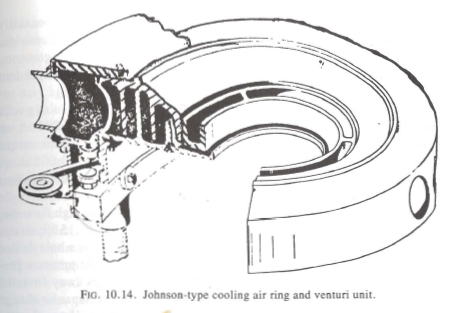
The controlling factor in the design of blown-film dies is the requirement for uniformity in the wall of the extruded tube. A parallel requirement is uniformity in the melt characteristics of the plastics material being processed. The exact thickness of the tube wall is not critical, inasmuch as the blow-up ratio and the pull-speed are the primary controls for the film thickness. For the same reason, die-swell is not considered in the blown-film-die design. Fig below illustrates the Johnson-type cooling ring and venturi unit. Film must not be brought into contact with a cool or cold surface while the film is still hot from the extruder. The cooling effect of expanding compressed air is utilized by this unit as it surrounds the just-blown bubble. The venturi unit also acts as a centering device and a support for the film in the critical first stage of cooling. However, each material and each gauge of film has its own peculiar cooling and handling character for which a cooling ring and venturi unit must be designed.
Computer Aided Design (CAD) is frequently used to design tubing dies for blown-film. It is true that the basic design is relatively simple. However, the very large dies and the very thin tube walls introduce complexities in the design. Critical elements become heater placement, heater wattages, temperature control, and even the stresses and/or distortions created by the heating of massive die sections.

