Address
304 North Cardinal St.
Dorchester Center, MA 02124
Work Hours
Monday to Friday: 7AM - 7PM
Weekend: 10AM - 5PM

Address
304 North Cardinal St.
Dorchester Center, MA 02124
Work Hours
Monday to Friday: 7AM - 7PM
Weekend: 10AM - 5PM
Mold Cost Analysis
Enough to meet volume with room to spare, and no more than the press, the part and the tolerance allow. Cavity count is a volume question first and a cost question second. Your annual part count, cycle time and press hours set the lowest count that can meet demand. Press limits and part size then cap that count. Cost per part falls as cavities rise, but only until balance, maintenance, scrap and downtime eat the gain.
Cavity count changes mold price, piece price, press size and risk at the same time.
One cavity makes one part per shot. Four cavities make four parts per shot, at roughly the same cycle time. That sounds like free output, and it is not. Each added cavity adds steel, machining time, cooling lines and a gate. It also adds a new source of variation, because no two cavities fill exactly alike.
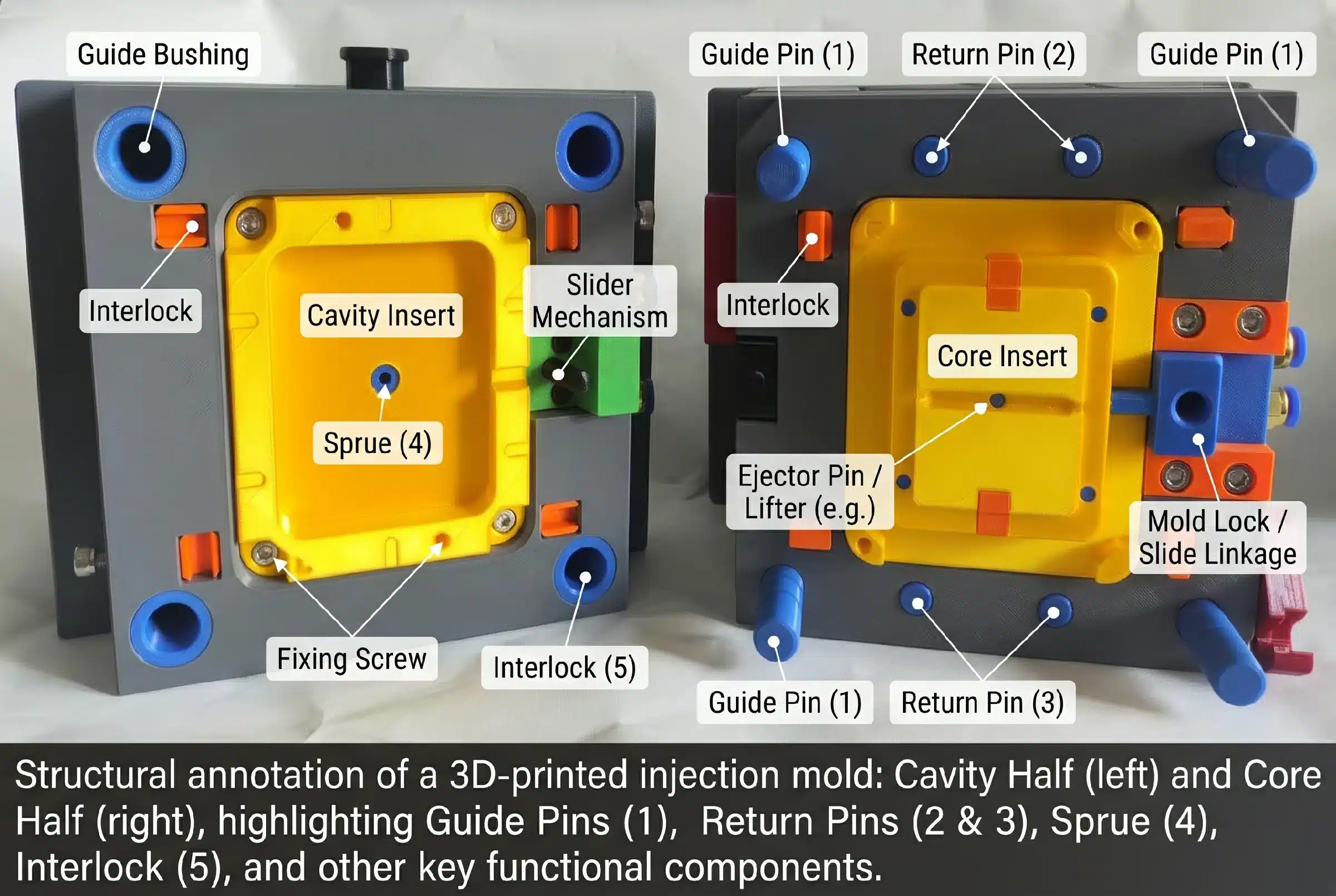
Protolabs puts it plainly in its multi-cavity design guide. The two main reasons to add cavities are demand and piece price. The same guide warns that more cavities do not always cut cost. Tool price and part price cross at some volume, and that crossing point moves with the part.
To compare two mold quotes with different cavity counts is to compare two different tools. Line up the scope first, then the price.
Work from the volume first, because the arithmetic is simple and it stops guesswork.
Cavities = annual volume × cycle time ÷ (press hours × 3,600 × efficiency)
Efficiency covers downtime, changeovers and rejected parts, so use a planning figure below 100 percent. Use 80 percent for planning unless your molder gives you a measured figure from a running job.
Here is a worked example with stated inputs, not a promise. A buyer needs 240,000 parts a year, the cycle runs 24 seconds, and the press is free 4,000 hours a year. At 80 percent efficiency, one cavity gives 11,520,000 seconds of press time a year. The job needs 5,760,000 seconds, so one cavity covers it with half its time spare.
Raise the volume to 1,200,000 parts and the same arithmetic asks for 2.5 cavities. You cannot build half a cavity, so the minimum becomes three, and four is the usual layout. That step from three to four is a layout choice, not a volume need.
Ask the mold maker to show this arithmetic on the quote, with the cycle time and press hours stated. If the cycle time on the quote is a guess, the cavity count is a guess too.

Volume gives a minimum, and the press gives a maximum. Shot size is the first limit, since the barrel must hold the full shot, parts plus runner, with room left.
Clamp force is the second limit, since projected area times cavity pressure sets the tonnage the press must hold. A four-cavity mold needs roughly four times the clamp force of one cavity for the same part.
Platen size is the third limit, since the mold base must fit, with space for clamps, water lines and ejection.
Part size sets a separate limit that has nothing to do with the press. A large housing may fill one cavity and leave no room for a second. A small cap or connector can run 16 or 32 cavities in the same mold base.
Part complexity cuts the count too. Protolabs notes that side actions and hand-loaded inserts work well in a single cavity, yet become slow and costly across eight cavities. A part with a side hole or an undercut needs that check before the count is set.
Ask for the press tonnage and the shot size on the quote, in writing.
Each added cavity cuts press time per part, yet it raises mold price and maintenance load. The saving per part shrinks as the count grows, while the mold price keeps climbing. That is the cost curve, and it flattens fast after four cavities for most mid-size parts.
Work the payback in parts, not in months. Take the extra mold price and divide it by the saving per part. The result is the part count that repays the extra tool. If your program never reaches that count, the extra cavities cost money instead of saving it.
| Cavities | Mold price | Press time per part | Watch out for |
|---|---|---|---|
| 1 | Lowest | One part per shot | Volume limit on large orders |
| 2 | Higher | Half the press time per part | Balance between two cavities |
| 4 | Higher still | A quarter of the press time | Runner balance and gate size |
| 8 | Highest of the four | An eighth of the press time | Variation, maintenance and press size |
Press time per part assumes the same cycle time for each count. Mold prices here are relative, not quoted figures.
Our cost page shows how part cost is estimated, starting with material weight and press time.
A cold runner adds waste to the same arithmetic, since every shot throws away the runner weight. A hot runner removes that waste, yet it adds manifold, nozzles, heaters and a controller to the mold price. Read our hot runner guide before you price that choice.
A count that fits year one can fall short in year three. A second mold then costs more than a bigger first mold would have. Ask for the volume forecast by year, not one total, before the count is fixed.
More cavities mean more parts per shot, and more chances for one cavity to drift from the rest. The runner is the main source of that drift, not the steel.
MoldMaking Technology reports that shear in the runner is the major cause of variation in multi-cavity molds. Melt at the runner wall runs hotter and thinner than melt at the center, so branches feed cavities unevenly. One cavity fills first, packs harder, and makes a heavier part, while a late cavity packs less and shrinks more.
A study cited by the same magazine found 60 to 70 percent of product variation in multi-cavity molds came from shear imbalance. The study ran at Penn State Erie and was published at ANTEC 98.
That is why balance is a design task, not a press setting. MoldMaking Technology gives a clear test for cavity balance. All cavities should fill at the same time, at the same shear rate. When balance cannot be held within 95 percent, the same article points to melt management as a fix, not a cure.
The check that matters is part weight by cavity, measured at T1 and logged shot by shot. Gate and runner size set the starting point for that balance. As a rule of thumb in the same article, gates run 40 to 60 percent of part thickness. Runner size grows about 25 percent at each branch, so shear stays even above and below the split.
Tight tolerance makes all of this harder, because a small weight gap can push a dimension out of spec. For a tight-tolerance part, a lower count with a wide process window often beats a high count that needs constant tuning. The gate, runner and cooling choices behind that balance are DFM calls, so settle them before steel is cut.
Ask for the volume arithmetic first, with cycle time and press hours stated. Then ask for the press that will run the mold, with tonnage, shot size, mold base size and water lines.
Ask how each cavity will be gated, and what the runner layout does to balance. Ask for the cavity balance target in percent, and how it will be measured at T1. Ask for part weight by cavity in the T1 report, not one average weight for the shot.
Ask what a single damaged cavity costs in downtime, and whether spare inserts ship with the mold. A mold with no spare insert plan can sit idle while one cavity is repaired.
Ask for the maintenance plan too, and how often the mold is pulled, cleaned and checked for wear. More cavities mean more gates and more cooling lines, so the maintenance plan matters.
Compare the quotes only after every supplier has answered the same questions, on the same scope.

